 Teotihuacan Pyramids Tours
What Was Found Under the Pyramid of the Sun in 1971?
In 1971 archaeologists found a stairway cut into bedrock at the foot of the Pyramid of the Sun, leading to a 103 m cave tunnel that ends in four chambers shaped like a cloverleaf. What was found under the Pyramid of the Sun in 1971 was a cave the builders knew about and used, with broken pottery and two engraved basalt discs left in the end chambers. This page covers the discovery, whether the cave is natural, why the pyramid sits on top of it, how it differs from the tunnels found later at Teotihuacan, and how to see the pyramid from Mexico City.
Quick answer
Late in 1971 a rubble-filled pit 7 m deep at the foot of the Pyramid of the Sun opened onto a rock-cut stairway and a 103 m cave tunnel ending in four chambers under the pyramid's centre. It is a natural lava cave that Teotihuacan's builders walled, plastered and sealed, and the chambers held crude pottery and two engraved basalt discs.
Key takeaways
- Ernesto Taboada, then in charge of the site, found the entrance, and Jorge Acosta of INAH led the clearing: the discovery
- A geologist dated the lava flow that formed the cave to more than a million years ago, so the cave is natural but modified
- The tunnel mouth lines up with the middle of the pyramid's original stairway, which suggests the builders chose this spot on purpose
- The 2003 tunnel under the Feathered Serpent temple is a different find: what else lies under Mexican pyramids
- The cave is not part of the public visit, but the pyramid is: see it on a guided half day from Mexico City
Walk Up to the Pyramid of the Sun With a Guide
The cave sits under the pyramid, and the pyramid is what you can actually visit. These tours suit travellers who want the discovery explained at the foot of the stairway.
Private Teotihuacan Tour with Historian Hector (5 Hours, SUV Pickup)
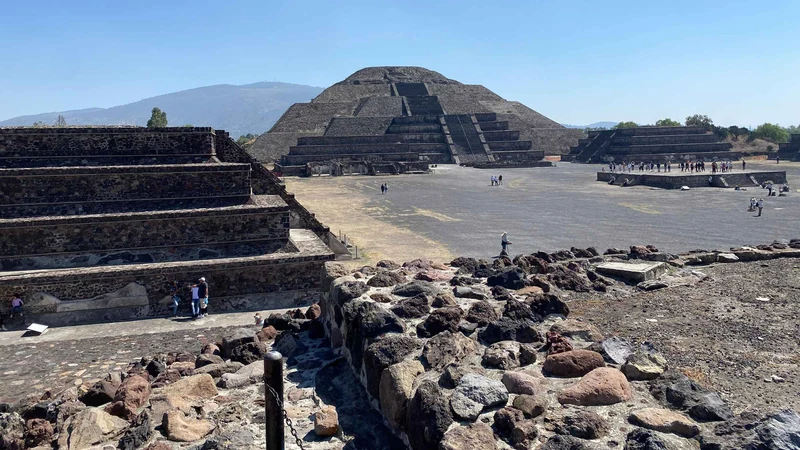
This is the pyramids-only option for people who want depth without the 8–11 hour day: Hector, a historian versed in Nahuatl language and Teotihuacan cosmology, drives you in a private SUV, covers five structures including the often-skipped Pyramid of the Feathered Serpent and Palace of Quetzalpapalotl, and has you back at your hotel by about 12:10 PM. It scores a perfect 5.0 across all 10 reviews. Be aware it is not suitable for children under 15, pregnant women, or travelers with back, heart, or mobility problems — and no food or beverages are included. Hotels outside the standard pickup areas need to send a full address before booking.
- Cancellation
- Free cancellation, full refund
- Operator
- Hector (private historian guide)
Teotihuacan Early Access Small-Group Tour
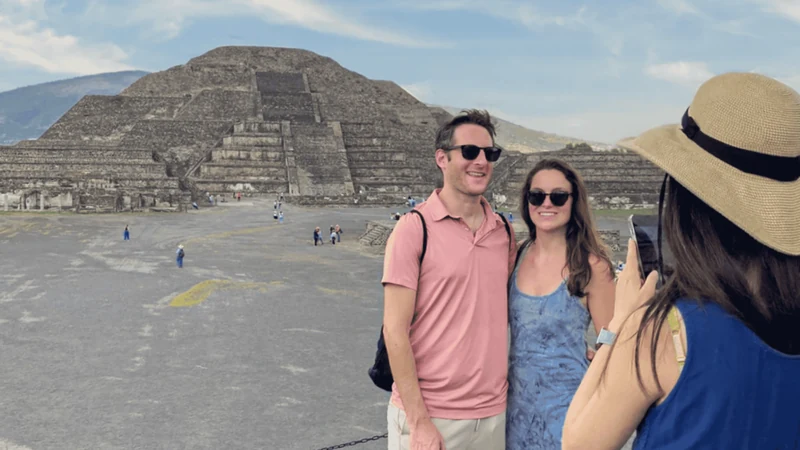
The early-departure option: 6:20 AM start puts you on site at 8–9 AM, when the Avenue of the Dead is quiet, the light is at its best, and the Pyramid of the Sun has no queue — most tour buses arrive between 10 AM and noon. Capped at 15 travelers with fast-track entry and a fully bilingual guide. One honest caveat from reviews: the 'box lunch' add-on is a lunch for the bus ride, not a ticket to the restaurant buffet, which you pay for separately.
- Cancellation
- Free cancellation, full refund
- Operator
- Amigo Tours
Teotihuacan Skip-the-Line Guided Tour with Entry Ticket
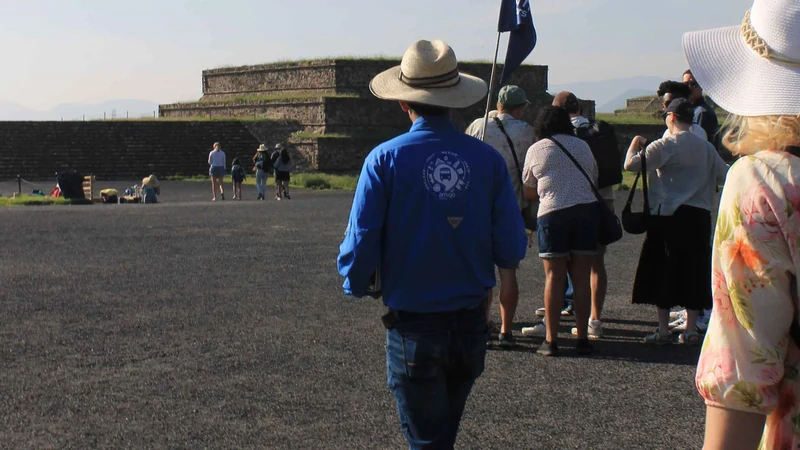
Built for travelers already at Teotihuacan or arriving independently by bus, car, or rideshare, this is the site's cheapest guided option by a significant margin, using the same Amigo Tours LATAM guides (Lily, Alfonso, Alex, Sal, Eliezer) who run pricier tours. Skip-the-line entry through the express security check and the entry ticket are included, with live commentary in English and Spanish. The important caveat: despite 'transportation to the site' appearing in the inclusions list, the operator's description confirms no transport is provided — you must reach Gate 1 on your own. Arrive at least 15 minutes early; the guide finds you in the ticket queue.
- Cancellation
- Free cancellation, full refund
- Operator
- Amigo Tours LATAM
What Was Found Under the Pyramid of the Sun in 1971?
A buried shaft, a rock-cut stairway and a 103 m tunnel
Toward the end of 1971 a depression at the foot of the main stairway of the Pyramid of the Sun was examined by Ernesto Taboada, then in charge of the archaeological zone. He found the entrance to a pit seven metres deep that had been filled with rocks and rubble many centuries earlier. Once cleared, it showed a semi-destroyed stairway cut out of bedrock, and the stairway led down to a cave tunnel running under the pyramid.
The tunnel ends in a set of chambers in the form of a cloverleaf. Like the pyramid's main facade, the mouth of the tunnel faces west. Jorge Acosta of the Instituto Nacional de Antropologia, which is now INAH, was in charge of clearing and consolidating the find.
| What | Detail |
|---|---|
| Entrance | A pit 7 m deep at the foot of the main stairway, filled with rubble |
| Access | A semi-destroyed stairway cut out of bedrock |
| Tunnel | 103 m long, mouth facing west |
| End of the tunnel | Four chambers in a cloverleaf, almost directly under the pyramid's centre |
| Original layout | 25 to 30 chambers, formed by walls that crossed the tunnel at different times |
| Objects | Numerous crude clay vessels and two thin engraved basalt discs |
The two engraved discs
The most striking objects were two thin basalt discs found in the end chambers. One is engraved with a human figure dressed in a jaguar costume and the other with a figure dressed as a bird. Both show Gulf Coast stylistic influence and traces of inlay that has since gone, and they appear to have been the backs of mirrors.
The clay vessels and the discs had both been broken on purpose when they were placed in the chambers.
Is the Cave Under the Pyramid of the Sun Natural or Man-Made?
A lava tube that people reshaped
Federico Mooser, a geologist at Mexico's national university who consulted for the institute, examined the cave and judged it a natural formation. As lava flowed into the Teotihuacan Valley more than a million years ago, gas bubbles formed. When new lava flowed over them, the bubbles stayed behind as underground caves, and such caves often served as outlets for springs. In his view the tunnel and the four end chambers formed this way.
Teotihuacan's builders then worked on it. They plastered the walls with mud, roofed parts of the tunnel with basalt slabs, some of which are still in place on the ceiling, and modified the end chambers by hand. The walls that once crossed the tunnel show that sections were closed off one after another, and Heyden reasoned that the cloverleaf at the far end would have been sealed first.
Scholars still disagree
The natural-cave reading is not the only one in print. Ivan Sprajc, who measured the orientation of the pyramid in 2000, writes that the cave under the structure is probably human-made. He also argues that the pyramid's location was set by astronomy and by the line to Cerro Gordo rather than by the cave.
The page on what the pyramids are aligned to explains that argument.
| Scholar | View of the cave | View of the pyramid's site |
|---|---|---|
| Federico Mooser, geologist, as reported by Heyden (1975) | Natural lava cave, with human modification | The cave may have fixed the site |
| Doris Heyden (1975) | A cult cave, compared with the mythical Seven Caves | The cavern may have determined where the pyramid was built |
| Ivan Sprajc (2000) | Probably human-made | Chosen for astronomical and topographic reasons, not for the cave |
When Was the Cave Used and When Was the Pyramid Built?
A shrine before the pyramid
Nobody can say when people first used the cave. Heyden notes that skeletal remains and charcoal are missing, because of ancient vandalism, so the earliest ritual use cannot be dated. She adds that the pottery and the discs could have been left there centuries after the natural tunnel became a shrine.
The pyramid itself comes later. Heyden describes the Pyramid of the Sun as probably the first major structure at Teotihuacan, built toward the end of the Tzacualli phase, which runs from CE 1 to 150, and followed by the Avenue of the Dead and the Pyramid of the Moon. Many references round the finished pyramid to about 200 CE. Before that the valley held dispersed hamlets with no ceremonial architecture, which led her to suggest that the sacred cave may have been the place of worship that drew people there in the first place.
Why Did Teotihuacan Build the Pyramid Over a Cave?
The tunnel lines up with the original stairway
Heyden's argument starts with geometry. The entrance of the 103 m tunnel coincides with the middle of the pyramid's original central stairway, which Acosta found during the installation of a sound-and-light show at the site. The tunnel then ends almost directly under the pyramid's centre. Her conclusion is that the cave was known when the pyramid was planned.
In central Mexican belief a cave was a place of origin, an entrance to the underworld and a source of water. She compared the four-chamber cloverleaf with the glyph for Chicomoztoc, the Seven Caves from which Aztec tradition said peoples emerged, and suggested the end chambers were the most sacred part of the cave, closed off first. She also pointed to an old Aztec tradition that rulers lay buried beneath the pyramid and proposed that it may have rested on fact. No burial has been reported from the cave itself.
A pyramid that belongs to water and earth
Heyden linked the cave to the water and earth deities, because a spring may once have run inside it and springs were openings to the underworld. She noted that a line of vegetation on aerial photographs may mark an underground watercourse, an idea she credited to the archaeologist Rene Millon. This is her interpretation, and the pyramid's builders left no written explanation, so treat it as the best-argued reading and not as settled fact.
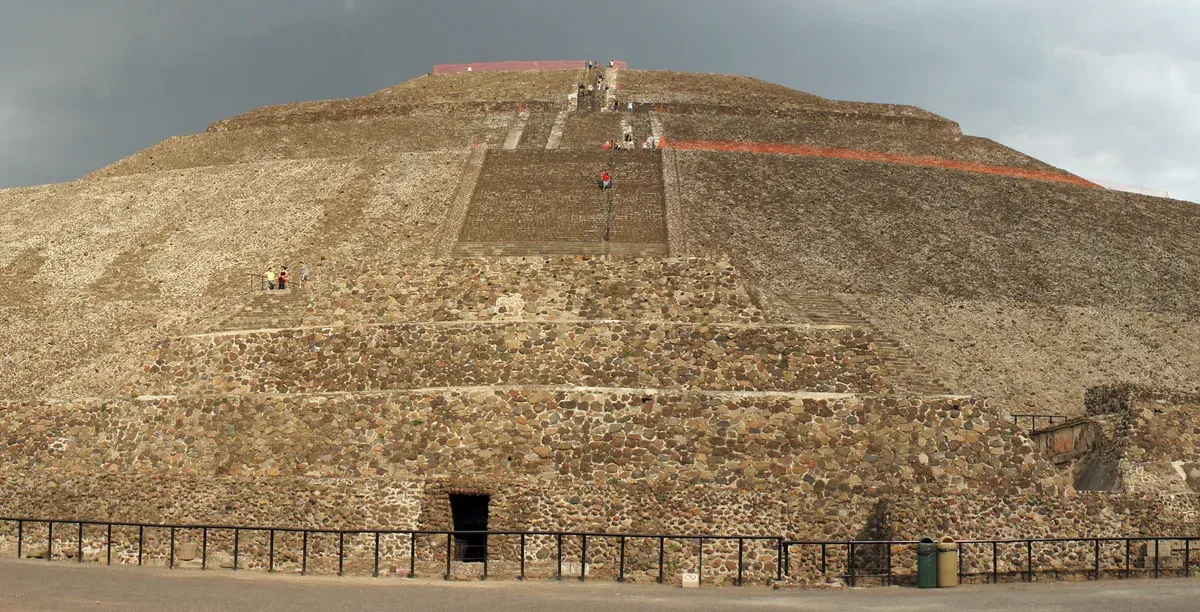
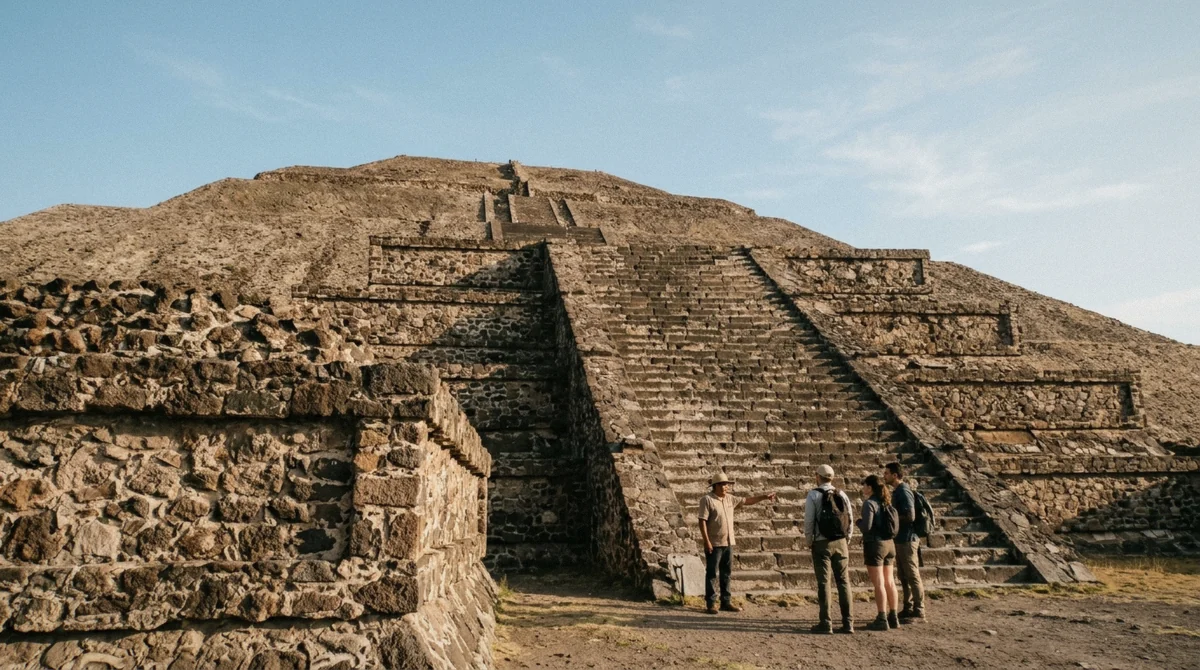
The stairway of the Pyramid of the Sun. Photo: Mariordo (Mario Roberto Durán Ortiz), CC BY-SA 3.0, via Wikimedia Commons
What Was Found Inside Other Pyramids in Mexico?
The Sun pyramid cave is one of several finds
The 1971 cave is often confused with the tunnel under the Temple of the Feathered Serpent in the Ciudadela, which was found more than thirty years later. They are separate discoveries in different parts of the city. The Feathered Serpent tunnel was found in late 2003 by the INAH archaeologists Sergio Gomez Chavez and Julie Gazzola after heavy rain opened a crack in front of the temple. A robot sent in 2013 found three chambers at the end of the 2,000-year-old tunnel, filled with mud and rubble. Gomez has suggested the tunnel was sealed to bury a ruler, but no tomb has been confirmed.
Other Mexican pyramids have given up different things. The table lists the best-known finds.
| Pyramid | What was found | When |
|---|---|---|
| Pyramid of the Sun, Teotihuacan | A 103 m cave tunnel, four end chambers, pottery and two engraved basalt discs | 1971 |
| Temple of the Feathered Serpent, Teotihuacan | A tunnel ending in three chambers, sealed in antiquity | Found in late 2003, robot survey in 2013 |
| Pyramid of the Moon, Teotihuacan | A cavity beneath the Plaza of the Moon, located by a resistivity survey and not entered | 2017 |
| Temple of the Inscriptions, Palenque | The tomb of the Maya ruler K'inich Janaab' Pakal | 1952 |
Why the finds cluster under the pyramids
The Sun pyramid cave formed in lava that once flowed into the valley, and Heyden argues the builders treated it as sacred. Most of what archaeologists have found at Teotihuacan lies underground, while a visitor sees only the stone surface. The Feathered Serpent tunnel is not open to visitors.
For the temple's own story, see the Aztec or Mayan guide, which covers who the builders were.
Is There a Tomb Under the Pyramid of the Sun?
No burial has been reported from the 1971 cave
No tomb has been reported from the 1971 cave. Heyden records that the walls inside carried openings made long ago by vandals, and later reporting on the Moon pyramid survey describes the Sun cave as looted, probably before the Spanish arrived. What archaeologists recovered was pottery and the two discs, which are ritual offerings and not a burial.
The ruler's tomb that people look for at Teotihuacan is still a question for the tunnel under the Feathered Serpent temple, where excavation has not confirmed one either. The reasoning is the same in both places. A sealed tunnel that ends under the centre of a monument looks like a burial, but digging has so far returned offerings and no named ruler.
Can You Go Inside the Cave Under the Pyramid of the Sun?
What you can visit instead
The cave is not part of the public visit. The archaeological zone is open daily from 8:00 AM to 5:00 PM, with last access at 4:30 PM, and the route stays above ground. What you can do is stand at the foot of the stairway where Taboada found the pit. The Pyramid of the Sun is about 63 to 65 m tall and is the third-largest pyramid in the New World, and it has been closed to climbers since 2020, as the climbing guide explains.
General entry is 210 MXN, about $11 at 19 pesos to the dollar, and Mexican nationals and residents pay 105 MXN. Bags are checked at the entrances. The cost guide covers the rest of the day.
Choosing a tour
Prices are the operators' listed figures per person, except the private tour, which prices the vehicle for the group. Entry is included on each of these Teotihuacan pyramids tours.
| Option | Best for | Duration | From |
|---|---|---|---|
| Private historian tour | Asking about the 1971 find with a historian guide | 5 hours | $135 |
| Early-access small group | A bilingual guide, on site at 8 to 9 AM | 8 hours | $68 |
| Half-day, first at the pyramids | Back in the city by about 1:30 PM | 5 to 6 hours | $38 |
| Skip-the-line guided tour | A three-hour walk, meeting the guide at the gate | 3 hours | $31 |
| Tlatelolco, Guadalupe and Teotihuacan | Three sites in one day | 9 hours | $71 |
Questions About the 1971 Cave
Who found the cave under the Pyramid of the Sun?
Ernesto Taboada, then in charge of the archaeological zone, found the entrance late in 1971. Jorge Acosta of INAH led the clearing and consolidation of the cave.
How long is the tunnel under the Pyramid of the Sun?
The tunnel is 103 m long and ends in four chambers shaped like a cloverleaf, almost directly under the centre of the pyramid.
Was the cave dug by the people of Teotihuacan?
A geologist judged it a natural lava cave more than a million years old that the builders walled, plastered and roofed. Ivan Sprajc, writing in 2000, thinks it is probably human-made. The alignment guide covers his view of the pyramid's site.
What is Chicomoztoc?
Chicomoztoc, the Seven Caves, is the mythical place of origin in ancient Mexican tradition. Doris Heyden compared the cloverleaf chambers under the Pyramid of the Sun with its glyph.
Is the Pyramid of the Sun hollow?
No. The 1971 passage runs through the bedrock beneath the pyramid and not through its body. The Mexican and Egyptian comparison gives the pyramid's size.
Can you climb the Pyramid of the Sun?
No. It has been closed to climbers since 2020. The morning bus tour walks the base and the avenue in a 5.5-hour round trip from Mexico City.