 Teotihuacan Pyramids Tours
What Are the Pyramids Perfectly Aligned to?
The Egyptian pyramids are aligned to the four cardinal directions, and the Great Pyramid of Giza faces true north within about three arcminutes, roughly one-twentieth of a degree. The Mexican pyramids follow a different rule. At Teotihuacan the whole city is rotated about 15.5 degrees clockwise from north, a skew that scholars tie to sunrise and sunset dates and to the peak of a mountain. So what are the pyramids perfectly aligned to? This page answers it for Giza and for Teotihuacan, separates the measured facts from the popular claims, and ends with where to see the Teotihuacan grid from Mexico City.
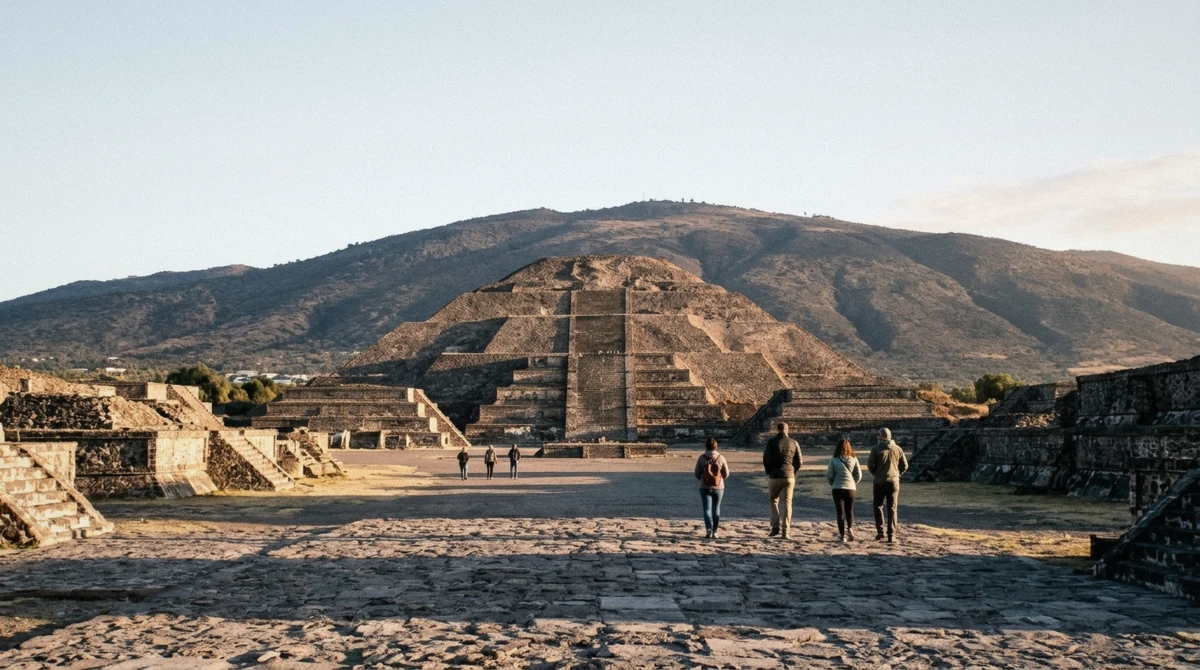
Quick answer
Giza's Great Pyramid is aligned to true north within about 3 arcminutes, and Egyptologists link that to two stars, Kochab and Mizar. Teotihuacan is not north-aligned at all: its grid is skewed about 15.5 degrees clockwise, and its Pyramid of the Sun lines up with sunrise and sunset dates 260 days apart and with the peak of Cerro Gordo.
Key takeaways
- Giza's sides deviate from true north by only about 3 arcminutes, far tighter than any Mexican pyramid
- Teotihuacan's skew is deliberate: the Avenue of the Dead runs at an azimuth of about 15 degrees 28 minutes, and the Pyramid of the Sun marks the dates
- The Orion belt theory for Giza is not accepted by Egyptologists: what is and is not supported
- Pyramids are not on one latitude: Giza is near 30 degrees north and Teotihuacan near 20, as the table shows
- See the grid from above on a sunrise balloon flight or at ground level on a half-day tour from Mexico City
See the Teotihuacan Grid From Mexico City
The skewed grid shows best from the air and from the Pyramid of the Moon plaza. These tours suit travellers who want the layout explained on site.
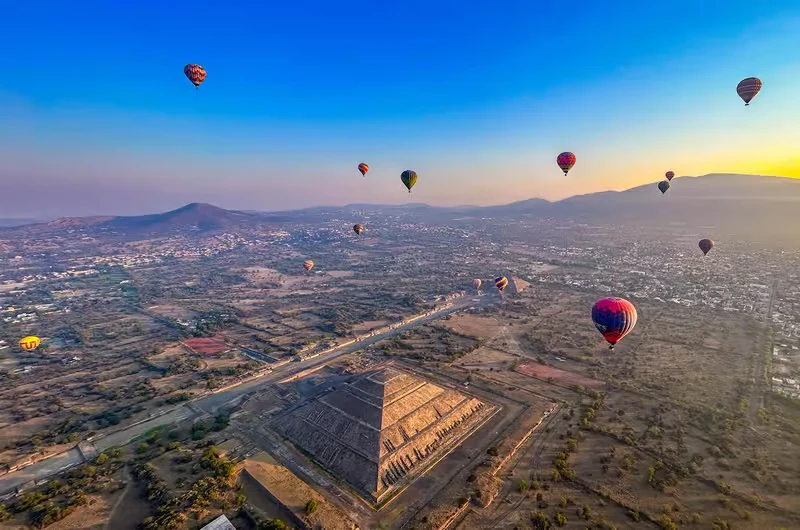
Teotihuacan Sunrise Hot Air Balloon Flight
From the air you see what ground touring can't show — the full scale of the Avenue of the Dead and the grid precision of the city, with pilots making several passes over the main structures. All three booking options include the post-landing sparkling wine toast and a flight certificate, and the full-day version adds the archaeological site and the Basilica of Guadalupe. Breakfast and lunch are at your own cost, and closed flat shoes are mandatory — no sandals, backpacks, or selfie sticks in the basket. Be warned: the transport option means a genuinely early pickup around 4:20 AM, and reviewers note the 11-hour full day is intense.
- Cancellation
- Free cancellation, full refund
- Operator
- None stated
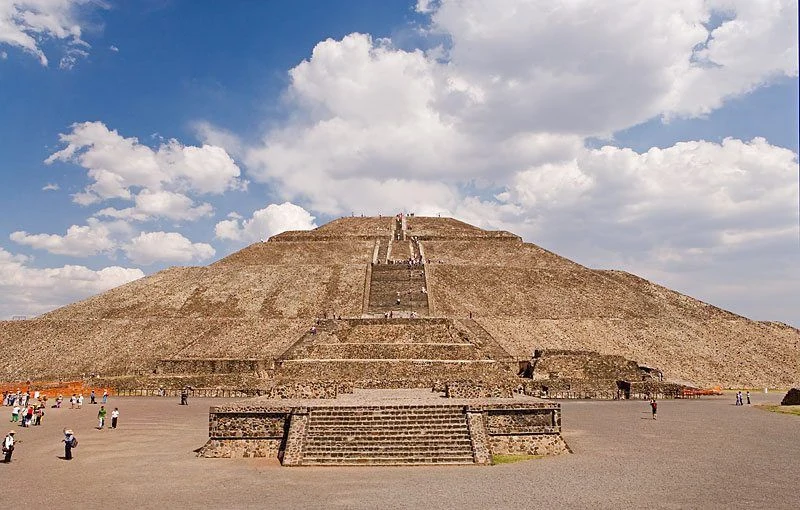
Teotihuacan Half-Day Tour — First at the Pyramids
The efficiency pick: first morning visitors at the site, a focused 2h40m guided circuit that deliberately starts at the Temple of Quetzalcoatl before crowds arrive, and a 1:00–1:30 PM return that leaves your afternoon free. Coffee stop en route is the only food opportunity before the pyramids — there are no food stops at the site, so bring water and sunscreen. One caveat from reviews: the Starbucks Reforma pickup intersection has three Starbucks locations — use the exact address (Av. Reforma 80) from your confirmation.
- Cancellation
- Free cancellation, full refund
- Operator
- None stated
Private Teotihuacan Tour with Historian Hector (5 Hours, SUV Pickup)
This is the pyramids-only option for people who want depth without the 8–11 hour day: Hector, a historian versed in Nahuatl language and Teotihuacan cosmology, drives you in a private SUV, covers five structures including the often-skipped Pyramid of the Feathered Serpent and Palace of Quetzalpapalotl, and has you back at your hotel by about 12:10 PM. It scores a perfect 5.0 across all 10 reviews. Be aware it is not suitable for children under 15, pregnant women, or travelers with back, heart, or mobility problems — and no food or beverages are included. Hotels outside the standard pickup areas need to send a full address before booking.
- Cancellation
- Free cancellation, full refund
- Operator
- Hector (private historian guide)
What Are the Pyramids Perfectly Aligned To?
Two different rules in two countries
There is no single alignment shared by the world's pyramids. Egyptian builders set the Giza pyramids to the cardinal directions, so each side faces north, south, east or west almost exactly. Teotihuacan's builders rotated the city about 15.5 degrees clockwise from north on purpose. A skew in that range, between about 15 and 18 degrees, turns up at many Mesoamerican sites, and Teotihuacan is the best-known example of what researchers call the 17 degree family of orientations.
The table sets the two rules next to each other.
| Question | Giza, Egypt | Teotihuacan, Mexico |
|---|---|---|
| Aligned to | True north, south, east and west | About 15.5 degrees clockwise from north |
| How tight | Great Pyramid within about 3 arcminutes of true north | Street of the Dead at about 15 degrees 28 minutes |
| Proposed method | Two stars, Kochab and Mizar, in line with the pole | Sunrise and sunset dates on the horizon, and Cerro Gordo |
| Purpose | Orientation of a royal tomb | Calendar dates and the layout of a whole city |
How Was the Great Pyramid Aligned to True North?
Two stars and a plumb line
The Great Pyramid's western and eastern sides deviate from true north by an average of about three arcminutes. Kate Spence of the University of Cambridge proposed in a 2000 paper in Nature that the builders found north by watching two stars, Kochab and Mizar, which lined up with the celestial pole in 2467 BCE. A plumb line hung from a sighting frame would have shown when the two stars stood one above the other.
The idea also explains why the pyramids are not all equally accurate. Over decades the stars drifted away from the pole, and the small differences between the earliest and latest pyramids match that drift. Other researchers dispute how precisely this dates the pyramids, so treat the method as the leading explanation and not as proof.
Are the Giza Pyramids Aligned to Orion's Belt?
The Orion correlation theory
The Orion correlation theory, popularised by Robert Bauval, says the three Giza pyramids mirror the three stars of Orion's Belt. Mainstream Egyptologists do not accept it, and it is a claim about the layout of three buildings, not about the north alignment of any one of them. The north alignment has a simpler explanation in the Kochab and Mizar method.
What Is Teotihuacan Aligned To?
A grid skewed 15.5 degrees from north
The street grid of Teotihuacan has been rotated about 15.5 degrees clockwise from the cardinal directions since the Tzacualli phase, CE 1 to 150. The Teotihuacan Mapping Project showed that two slightly different skews are built into the city. The Pyramid of the Sun, the Street of the Dead and most of the buildings in the centre deviate about 15 degrees 25 minutes. The Ciudadela and the two main east-west avenues beside it run about 16 degrees 30 minutes south of east.
Ivan Sprajc, who measured alignments at 37 pre-Hispanic sites, argues that the Pyramid of the Sun set the 15.5 degree skew, because it is the largest temple, was built when the grid was laid out, and points to Cerro Gordo. The Ciudadela set the second skew.
| Structure | Orientation | What it points to |
|---|---|---|
| Street of the Dead | Azimuth about 15 degrees 28 minutes | The north-south axis of the city |
| Pyramid of the Sun | North-south axis parallel to the street, east-west axis skewed about 15 degrees 45 minutes south of east | Cerro Gordo to the north, sunrises and sunsets on key dates |
| Ciudadela and east-west avenues | About 16 degrees 30 minutes south of east | A second set of sunrise and sunset dates |
How precise is the Teotihuacan alignment?
Far less precise than Giza, and the difference is worth knowing. The slanted faces of the Pyramid of the Sun are irregular even where original stucco survives, so its intended orientation cannot be fixed with great precision. The archaeologist Rene Millon measured it at 15 degrees 25 minutes east of north, and some readings taken on the south side, where the original construction is exposed, approached 16 degrees south of east.
The Street of the Dead is the better yardstick, because its azimuth can be measured to a minute. That is why the skew is quoted as about 15.5 degrees and not as a single exact figure.
What Do the Dates in the Teotihuacan Alignment Mean?
Sunrises and sunsets 260 days apart
Sprajc calculated that in the first century CE the east-west line of the Pyramid of the Sun, standing on the natural ground level, pointed to the sunrise on 11 February and 29 October and the sunset on 30 April and 13 August. Both the interval from 11 February to 29 October and the interval from 13 August to 30 April are exactly 260 days, the length of the sacred calendar count used across Mesoamerica.
He also notes that the base of the first construction stage of the pyramid measures 260 Teotihuacan units of 83 cm, according to a separate study. The author adds a caution. A 260-day interval between two dates does not by itself prove that the builders kept a fixed 260-day count. What it shows is that the pyramid's orientation recorded dates that matter to an agricultural and ritual calendar.
| Event | Date | Days to the next date in the pair |
|---|---|---|
| Sunrise along the east-west axis | 11 February | 260 days to 29 October |
| Sunrise along the east-west axis | 29 October | 105 days back to 11 February |
| Sunset along the east-west axis | 13 August | 260 days to 30 April |
| Sunset along the east-west axis | 30 April | 105 days back to 13 August |
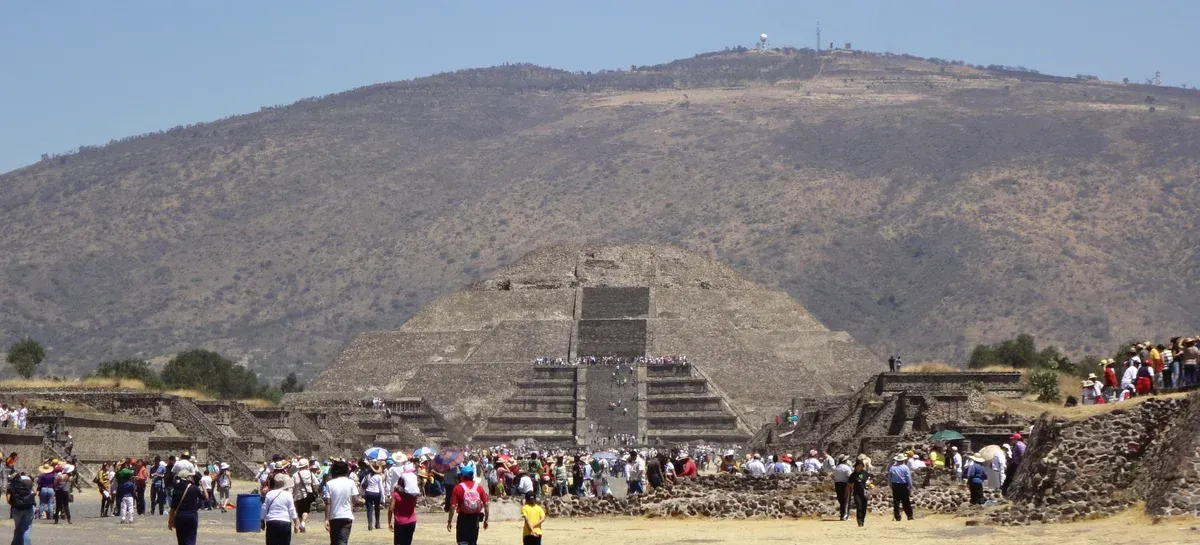
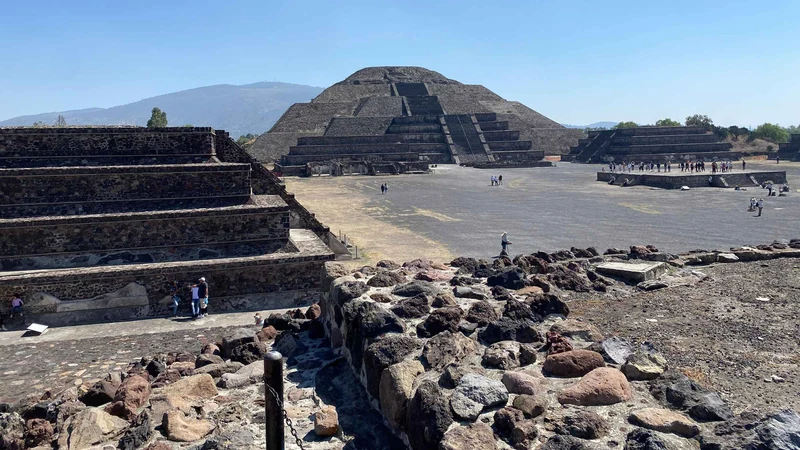
The Pyramid of the Moon with Cerro Gordo behind. Photo: Juan Carlos Fonseca Mata, CC BY-SA 4.0, via Wikimedia Commons
Does the Avenue of the Dead Point at Cerro Gordo?
The Pyramid of the Sun does, the avenue only roughly
Many guides say the Avenue of the Dead points at Cerro Gordo, the mountain behind the Pyramid of the Moon. The measurements are more careful than that. Sprajc credits the Pyramid of the Sun with being oriented to the summit of Cerro Gordo, at an azimuth of about 15.5 degrees, and notes that an earlier survey by Tobriner found that the avenue itself points to a spot just to the left of the peak.
The point matters for how you read the site. The avenue is the most visible part of the skewed grid, but the argument is that it follows an orientation set by the pyramid, and not the other way round. Walking north along the 2.4 km avenue, the mountain rises behind the Moon pyramid at the end.
Are All Pyramids on the Same Latitude?
No, they are about 10 degrees apart
The idea that the great pyramids share a latitude is a myth. Giza lies near 30 degrees north, Teotihuacan near 19.7 degrees north and Chichen Itza near 20.7 degrees north, so even the two Mexican sites are a degree apart. The sites simply sit in different places on the map, and no alignment rule ties them together.
| Site | Approximate latitude | Country |
|---|---|---|
| Giza | About 30.0 degrees north | Egypt |
| Chichen Itza | About 20.7 degrees north | Mexico |
| Teotihuacan | About 19.7 degrees north | Mexico |
| Cholula | About 19.1 degrees north | Mexico |
Which Alignment Claims Are Not Supported?
What the measurements do and do not show
Popular accounts add many claims to the measured alignments. The surveys cited on this page do not mention a scale model of the solar system along the Avenue of the Dead, hidden mathematical constants in the pyramids or a link between Teotihuacan and Orion. What they do support is narrower and still impressive: a deliberate skew, a mountain and a set of calendar dates.
One older hypothesis, from a 1967 survey by Dow, links the orientation of the Ciudadela to the setting of the Pleiades. Sprajc mentions it as an earlier proposal and explains the same orientation through sunrise and sunset dates, which he calculates stayed virtually the same for some 1,500 years. A good rule is to trust a claim when it comes with an azimuth, a date and a source.
| Claim | Status |
|---|---|
| Giza pyramid faces true north within about 3 arcminutes | Measured, with a leading explanation in two stars |
| Giza pyramids mirror Orion's Belt | Proposed, not accepted by Egyptologists |
| Teotihuacan grid skewed about 15.5 degrees | Measured and mapped |
| Pyramid of the Sun records dates 260 days apart | Argued from measurements, with the author's caution on a fixed count |
| Ciudadela tied to the Pleiades | Older hypothesis, not adopted in the 2000 study |
How to See the Teotihuacan Grid From Mexico City
Where the alignment is easiest to see
The skew is hard to feel at ground level and easy to see from above. The sunrise balloon flight is the one option among the tours of the Teotihuacan pyramids that shows the whole grid from the air. On foot, the Moon pyramid plaza at the north end gives the best view down the avenue, and the first section of the Pyramid of the Moon has been open to climbers since 19 May 2025, as the climbing guide explains.
The archaeological zone opens daily from 8:00 AM to 5:00 PM, with last access at 4:30 PM. General entry costs 210 MXN, about $11 at 19 pesos to the dollar, and Mexican nationals and residents pay 105 MXN. Bags are checked at the five entrances, so leave a large pack behind, as the safety guide explains. The photo spots guide shows where to stand for the mountain and the pyramid in one frame.
Choosing a tour
Prices are the operators' listed figures per person, except the private tour, which prices the vehicle for the group.
| Option | Best for | Duration | From |
|---|---|---|---|
| Sunrise balloon flight | The grid of the city from the air | 3 to 11 hours | $166 |
| Half-day, first at the pyramids | Back in the city by about 1:30 PM | 5 to 6 hours | $38 |
| No-commercial-stops tour | A direct return with no shopping | 6 hours | $36.88 |
| Private historian tour | Asking about the orientation with a historian guide | 5 hours | $135 |
Questions About Pyramid Alignment
Is the Great Pyramid aligned with true north?
Almost exactly. Its sides deviate by an average of about three arcminutes, about one-twentieth of a degree. Spence links that accuracy to the stars Kochab and Mizar.
Why is Teotihuacan tilted 15.5 degrees?
Sprajc argues the Pyramid of the Sun set the skew, because it points to Cerro Gordo and records sunrise and sunset dates. The 1971 cave under the pyramid is a related puzzle, because one scholar thinks the cave fixed the site and Sprajc thinks astronomy did.
Is the Pyramid of the Sun aligned with the equinox?
No. The dates its axis marks are 11 February, 30 April, 13 August and 29 October. The equinox serpent effect belongs to El Castillo at Chichen Itza, which is a different and later pyramid, as which is older, Chichen Itza or Teotihuacan explains.
What is the 17 degree family of orientations?
It is the name researchers give to alignments skewed about 15 to 18 degrees clockwise from the cardinal directions, which occur at many Mesoamerican sites. Teotihuacan is the best-known example.
Do the Mexican pyramids line up with the Egyptian ones?
No. They differ in latitude by about 10 degrees and follow different alignment rules. The Mexican and Egyptian comparison covers their ages and sizes.
Where is the best place to see the Teotihuacan layout?
From the air on the sunrise balloon flight, or along the 2.4 km Avenue of the Dead on foot.